South Korea EPS Salary in Pakistani Rupees 2026 – E-9 Visa
Updated on August 14, 2026
🔄 Last updated: August 14, 2026
south korea salary in pakistani rupees South Korea is one of the most sought-after destinations for Pakistani workers — and also one of the most misrepresented. Agents throw around figures like “5 lakh a month” with no basis. Here are the actual legal minimums for 2026, converted honestly, along with what they mean once you subtract the costs. If you haven’t yet gone through the application process, start with our South Korea EPS work visa guide before reading the salary numbers below.
The 2026 Numbers
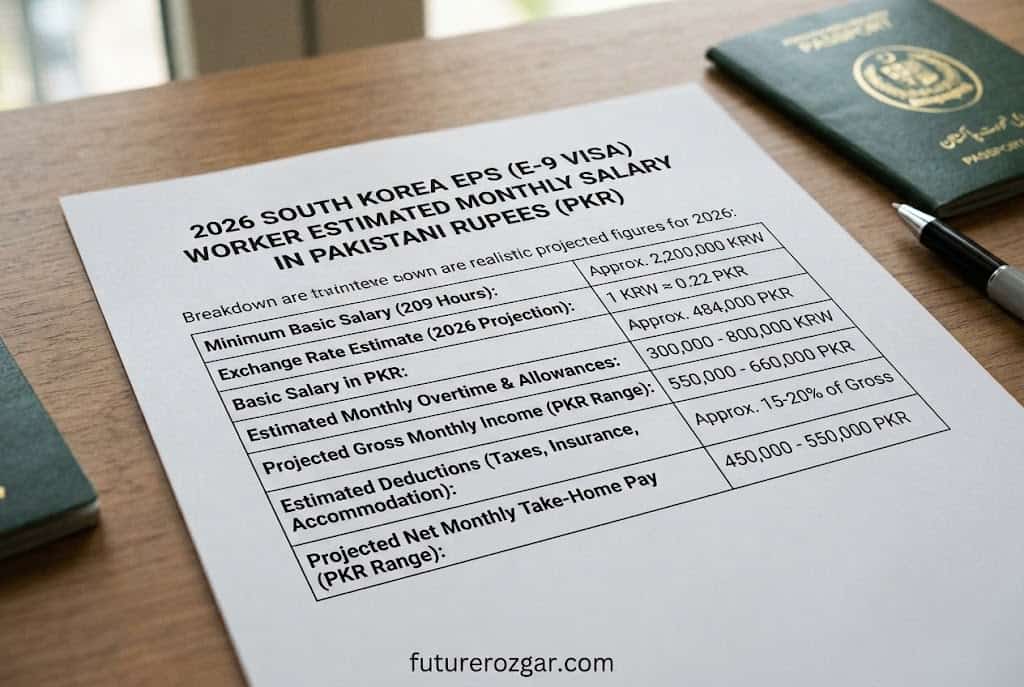
South Korea’s Minimum Wage Council set the 2026 minimum wage at KRW 10,320 per hour, up 2.9% from KRW 10,030 in 2025. Based on the standard 209-hour working month, that is KRW 2,156,880 per month before deductions.
Critically: South Korea’s Minimum Wage Act applies to all employees regardless of nationality. Foreign workers on the E-9 visa are legally entitled to the same minimum as Korean citizens.
south korea salary in pakistani rupees Converted to Pakistani Rupees
At an exchange rate of roughly 1 KRW = 0.18 PKR (July 2026):
Item
KRW
Approx. PKR
Minimum wage (hourly)
10,320
~Rs. 1,860
Minimum wage (monthly, 209 hrs)
2,156,880
~Rs. 388,000
With moderate overtime
2,500,000
~Rs. 450,000
With heavy overtime
3,000,000
~Rs. 540,000
The exchange rate is not stable. Over the past 90 days the KRW–PKR rate has moved between roughly 0.179 and 0.192. That swing alone changes a monthly salary by more than Rs. 25,000. Check the live rate before you make any financial plan around these figures.
south korea salary in pakistani rupees Now Subtract What Gets Taken Out
This is the part agents leave out. The figures above are gross. In South Korea, income tax, national pension, health insurance and employment insurance are deducted from your pay — together typically around 20%.
So a gross of Rs. 388,000 is roughly Rs. 310,000 net, before you have eaten or paid rent.
Nobody in Pakistan quotes you the net figure. Now you know to ask.
The Thing That Actually Makes EPS Work
Here is the genuinely important detail, and it is the reason EPS workers often save more than better-paid office workers in Seoul:
Under the E-9 visa, employers are legally required to provide accommodation, meals, or an equivalent allowance. Many EPS factory workers live in company dormitories at little or no cost.
Housing is the single largest expense in Korea. A studio in outer Seoul runs KRW 500,000–700,000 per month (Rs. 90,000–126,000); in a smaller city like Daegu or Gwangju, KRW 350,000–550,000. If your employer covers that, your savings rate transforms.
A frugal single person outside Seoul spends roughly KRW 1,200,000–1,600,000 (Rs. 216,000–288,000) per month excluding rent. Do the arithmetic against a Rs. 310,000 net with free housing, and the picture is genuinely good — which is exactly why it is worth doing this properly and not through an agent.
Overtime and Your Rights
Overtime, night shifts and holiday work are paid at 1.5× the base rate. This is law, not a favour.
You have the same labour protections as Korean workers — minimum wage, overtime, holidays, industrial accident insurance.
Wages must be paid on time. Employers who violate this face blacklisting from the EPS programme.
HRDKorea and the Ministry of Employment and Labor monitor employers specifically to prevent exploitation of foreign workers.
If an employer in Korea underpays you, that is illegal and there is a system to report it. You are not without recourse.
Very limited — no direct route to permanent residency or citizenship
Read those last three rows carefully. E-9 is a work-and-return programme, not an immigration route. After 4 years 10 months you must leave, and you cannot bring your family. Anyone telling you otherwise is lying to you.
How Pakistanis Actually Apply
The process is government-to-government. In Pakistan it runs through the Overseas Employment Corporation (OEC), which operates under the Ministry of Overseas Pakistanis and Human Resource Development. For the full step-by-step process, see our South Korea EPS work visa guide and the OEC overseas jobs registration guide.
Pass the EPS-TOPIK — the Korean language and job aptitude test, taken in Pakistan. Your score directly affects your chance of being matched with an employer.
HRDKorea matches you with a Korean employer based on your test score and their needs.
Sign the employment contract and receive your Confirmation of Visa Issuance (CVI).
Apply for the E-9 visa at the Korean embassy.
Within 15 days of arrival, register at the local immigration office for your Alien Registration Card.
Read This Before You Pay Anyone Anything
South Korea work visas are one of the most heavily targeted scams in Pakistan. People lose lakhs.
EPS is government-to-government. There is no agent. OEC is the only legal channel. Nobody can “arrange” a Korea visa for you.
You cannot skip the EPS-TOPIK. No amount of money bypasses the language test. If someone offers this, they are stealing from you.
The official fee is a nominal processing charge paid by bank challan — typically a few thousand rupees. Not lakhs. If the number has six digits, walk away.
You are not “selected” before you take the test. Any call claiming you have already been selected for a Korean factory is a fraud.
Verify everything on oec.gov.pk. Not on a Facebook page, not from a WhatsApp contact, not from a “consultant” in a shopping plaza.
The genuine route is slow, competitive and requires you to learn Korean. That is not a bug — that difficulty is precisely what makes the salary figures above real rather than imaginary.
Disclaimer: FutureRozgar shares information for the benefit of job seekers. We do not charge any fee, we are not a recruitment agency, and we are not affiliated with OEC or the Korean government. Salary figures are based on South Korea’s published 2026 statutory minimum wage and are converted at an approximate exchange rate — actual take-home pay depends on hours worked, deductions, and the exchange rate on the day. Verify all details from official sources before making any decision. Read More : Bank of Punjab Jobs 2026 – PBO, CSO, IT & Cyber Security | Apply Online