South Korea Jobs for Pakistanis 2026: EPS Visa via OEC
Updated on August 7, 2026
🔄 Last updated: August 7, 2026
South Korea Jobs for Pakistanis 2026 Ask any overseas worker which country offers the best deal for labor jobs, and South Korea comes up again and again. The reason is simple: Pakistan has a government-to-government agreement with South Korea under the Employment Permit System (EPS). No private agents, no massive visa “fees”, written contracts, and wages that beat most Gulf jobs. Here’s how the whole system works in 2026.
What is the EPS (E-9 Visa) Program?
The Employment Permit System lets small and medium Korean companies legally hire foreign workers in sectors facing labor shortages: manufacturing (factories), construction, agriculture, fisheries and some services. Pakistan is one of 16 countries in the program. On Pakistan’s side, everything runs through the Overseas Employment Corporation (OEC); on Korea’s side, through HRD Korea under their Ministry of Employment and Labour. Selected workers travel on an E-9 work visa with a written employment contract, and Korean labor laws apply to them.
How Much Can You Earn?
Korea’s minimum wage in 2026 is around ₩9,860 per hour — which works out to roughly PKR 200,000 per month in base wages, before overtime. Most EPS workers earn more with overtime, and employers commonly provide accommodation and food. For many workers, this is more than formal-sector professional salaries in Pakistan.
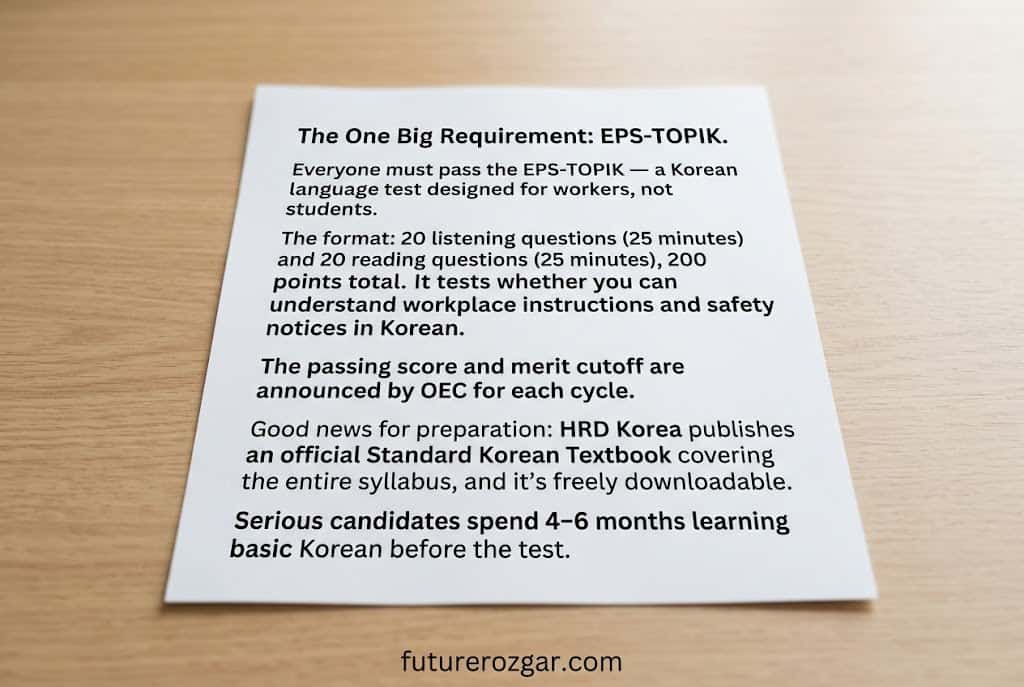
The One Big Requirement: EPS-TOPIK
Everyone must pass the EPS-TOPIK — a Korean language test designed for workers, not students. The format: 20 listening questions (25 minutes) and 20 reading questions (25 minutes), 200 points total. It tests whether you can understand workplace instructions and safety notices in Korean. The passing score and merit cutoff are announced by OEC for each cycle.
Good news for preparation: HRD Korea publishes an official Standard Korean Textbook covering the entire syllabus, and it’s freely downloadable. Serious candidates spend 4–6 months learning basic Korean before the test.
The Process, Start to Finish
Pre-register with OEC — create your profile at jobs.oec.gov.pk (the EPS-TOPIK registration portal for 2026 is live on the OEC site)
Register for EPS-TOPIK when OEC announces the cycle — registration windows, test centers and dates are published on oec.gov.pk
Pass the test — high scorers enter the job-matching pool
Get matched with a Korean employer — HRD Korea’s system matches workers to companies
Medical, contract and visa — OEC guides selected candidates through medical tests, contract signing and E-9 visa processing
Pre-departure training and fly to Korea
Important Warnings
Registration cycles are announced irregularly — monitor oec.gov.pk and its EPS notice section regularly so you don’t miss a window
There is no agent route to EPS Korea. Anyone selling “Korea visas” outside OEC is a fraudster — the only official fee is OEC’s registration charge
Start learning Korean now, before the next cycle opens. Most people fail EPS-TOPIK because they start studying after registration
FutureRozgar is an information website. Test dates, passing scores and registration windows change each cycle — always confirm current announcements at oec.gov.pk before acting.
How to Prepare for EPS-TOPIK From Pakistan
EPS-TOPIK is a pass-or-nothing gate, so treat preparation like a part-time job for three to six months. The test covers reading and listening built around workplace Korean — safety instructions, machine operations, everyday conversation. Build your plan on the official EPS-TOPIK textbook (freely available as PDFs with audio from HRD Korea), learn Hangul script in the first two weeks (it is genuinely learnable in days), then grind the standard question bank until the recurring patterns feel familiar. Supplement with YouTube EPS-TOPIK channels and past-paper drills. Candidates from Pakistan who clear it almost universally credit daily consistency over expensive academies — though a structured class helps if self-study discipline is a struggle.
Which Sectors Can Pakistanis Work In?
EPS demand from Korea comes primarily in manufacturing (factory production lines — the largest share), agriculture and livestock, fishing, and construction depending on the year’s quota. Manufacturing offers the most regular hours and dormitory arrangements; agriculture and fishing can involve harder physical conditions in rural areas but sometimes faster selection due to lower competition. You indicate sector preferences during the process, and your test score plus a skills evaluation influence how quickly employers pick you from the roster.
Your Rights and Protections Under EPS
EPS exists precisely to replace exploitative middlemen with a government-to-government system, and it comes with real protections: a standard labor contract you sign before departure, coverage under Korean minimum wage and labor law like local workers, mandatory insurances (departure guarantee, return cost, casualty), and access to HRD Korea support centers with interpreters for disputes. Workers can change workplaces in defined situations such as unpaid wages or contract violations. Learn these rights during pre-departure orientation — workers who know the complaint channels resolve problems; those who don’t, suffer silently.
Savings Potential: Why Korea Ranks So High
Korea’s minimum wage is among the highest available to Pakistani workers abroad, and overtime — common in manufacturing — is paid at premium rates by law. With employer-arranged dormitories keeping housing costs low, disciplined workers routinely remit substantial amounts monthly, and completing the full EPS period with a clean record can build capital that transforms a family’s finances. The trade-off is real: the work is demanding, winters are harsh, and the culture expects intensity. Go in with clear financial goals and the years pay off.
The Sincere Worker Advantage
Workers who complete their contract with the same employer without violations can qualify for Korea’s committed/sincere worker re-entry track — returning to Korea with simplified procedures, sometimes without retaking the language test. This makes your conduct in the first contract a long-term investment: one clean stint can turn into a decade of high-earning cycles.
Frequently Asked Questions
How many times can I attempt EPS-TOPIK?
There is no lifetime attempt limit — you can register again in future test rounds announced by OEC, as long as you remain within the age bracket (generally 18–39).
Passing the test guarantees a job, right?
No — passing puts you on the roster from which Korean employers select. Higher scores, useful skills and flexible sector preferences all raise your pick rate. Some rostered candidates wait months; keep your documents current during that period.
Can women apply for EPS Korea?
Yes, the program is open to women, though demand composition (heavy manufacturing, agriculture, fishing) means fewer placements historically go to female applicants from Pakistan. Watch each round’s announcement for sector details.
What does the process cost through OEC?
Official costs are limited to the announced test fee, medical examination, visa and airfare-related expenses, paid through official channels. Anyone demanding lakhs for “guaranteed EPS selection” is a fraudster — selection runs on your test score, not connections.
Can EPS lead to permanent settlement in Korea?
EPS is a temporary work program, but long, clean service combined with skills exams can open pathways to higher visa categories in Korea’s evolving system. Treat any such transition as a bonus, not the plan — the reliable win is the earning cycle itself.