Japan Jobs for Pakistanis 2026: TIT & Skilled Worker (OEC)
Updated on August 7, 2026
🔄 Last updated: August 7, 2026
Japan Jobs for Pakistanis 2026 Everyone talks about Korea, but Japan has quietly become one of the best legal work destinations for Pakistanis — and the government route through the Overseas Employment Corporation (OEC) means no agents and no fake visa fees. Japan is facing serious labor shortages, and its doors are open through structured programs. Here’s what’s available and how it works.
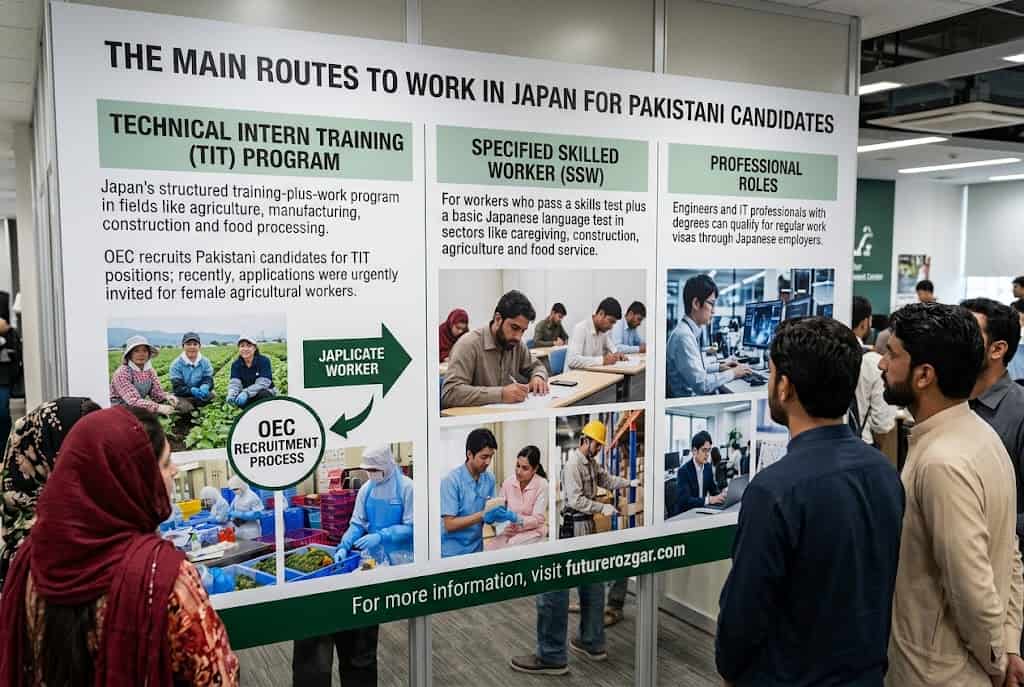
The Main Routes to Work in Japan
Technical Intern Training (TIT) Program — Japan’s structured training-plus-work program in fields like agriculture, manufacturing, construction and food processing. OEC recruits Pakistani candidates for TIT positions; recently, for example, applications were urgently invited for female agricultural workers under this program.
Specified Skilled Worker (SSW) — for workers who pass a skills test plus a basic Japanese language test in sectors like caregiving, construction, agriculture and food service.
Professional roles — engineers and IT professionals with degrees can qualify for regular work visas through Japanese employers.
Why Japan is Worth Considering
Good salaries in a strong currency, with structured contracts and labor protections
Safe, disciplined working environment with real skills training
TIT and SSW experience can lead to longer-term work status in Japan
Government-facilitated recruitment through OEC removes the middleman risk entirely
What You Need
Requirements differ by program and vacancy, but generally expect: relevant work experience or skills in the announced field, basic Japanese language ability (programs usually include or require language training — start learning hiragana and everyday phrases early), medical fitness, and a valid passport. Each OEC announcement lists the exact criteria, so always read the specific advertisement.
How to Apply Through OEC
Register at jobs.oec.gov.pk and complete your profile with skills, experience and documents
Watch the OEC website for Japan announcements — TIT and other Japanese vacancies appear periodically
Apply against the open vacancy and deposit the official application fee mentioned in the announcement
Shortlisted candidates go through interviews/selection with the Japanese side
Selected candidates receive language/pre-departure training and visa processing support
Stay Safe
Japan visas are a favorite tool of fraudsters in Pakistan. Remember: the legal routes are OEC and licensed overseas employment promoters (verifiable at beoe.gov.pk). Nobody can “guarantee” you a Japan visa for cash, and any demand for large payments is a scam. For OEC queries, use the official helpdesk: 0311-0011-632 or helpdesk@oec.gov.pk.
FutureRozgar is an information website. Vacancy availability, criteria and dates change — always confirm the current announcement on oec.gov.pk before applying.
TIT vs Specified Skilled Worker: Which Route Is Yours?
The two programs serve different profiles. The Technical Intern Training (TIT) route is a structured 3-to-5-year training placement — you learn a trade inside a Japanese company, earn while training, and need little to no prior Japanese at entry for many placements, since language training is built into the program. The Specified Skilled Worker (SSW) visa is direct employment for people who can already prove their skills and Japanese ability through sector skill exams and a language test. Fresh candidates usually start with TIT; experienced workers who pass the exams can enter SSW directly at better pay. Importantly, TIT graduates can transition into SSW afterwards, turning a training stint into a long-term Japan career.
The Japanese Language Reality
Language is the single biggest filter — and the biggest opportunity, because most Pakistani applicants avoid it. SSW requires passing the JFT-Basic or JLPT N4 level: everyday Japanese, roughly achievable with several months of serious study. Free and low-cost resources (NHK lessons, Minato e-learning, YouTube courses) plus NAVTTC’s Japanese language programs make this realistic from Pakistan. Candidates who arrive with N4 and push toward N3 while working consistently report better assignments, better treatment and faster raises than those who stay at survival level.
What Can You Realistically Earn and Save?
Japanese wages follow regional minimum wage laws, and employers must pay interns and workers legally like local staff — one of the program’s core protections. After deductions for taxes, insurance and dormitory-style housing (often employer-arranged at reasonable rates), disciplined workers typically save a meaningful share of income, especially outside Tokyo where living costs drop sharply. Exact figures vary by prefecture, sector and overtime, so treat any agent quoting a fixed fantasy salary with suspicion and rely on the contract you sign, which by law must state wages clearly.
Life in Japan: What Pakistani Workers Should Expect
Japan rewards punctuality, cleanliness and rule-following to a degree that surprises newcomers — being five minutes early is on time. Halal food is increasingly available in cities with Pakistani and Indonesian communities, mosques exist in most industrial areas, and colleagues generally respect prayer needs once explained. Winters in northern placements are severe; pack and budget accordingly. Workers describe the first three months as the hardest and the discipline learned as the most valuable thing they bring home besides savings.
Timeline From Application to Departure
Expect a longer runway than Gulf recruitment: language preparation (if starting from zero), OEC application and shortlisting, skills and language testing, employer matching, Certificate of Eligibility processing in Japan, then visa issuance and pre-departure orientation. Several months from start to flight is normal — candidates who begin language study before any advertisement appears effectively cut their timeline in half.
Frequently Asked Questions
Can I take my family to Japan?
TIT and SSW Type 1 do not allow family accompaniment. The higher SSW Type 2 category, available in certain sectors after proven experience, permits bringing a spouse and children — a strong long-term goal.
Is there an age limit?
Programs generally target younger workers, commonly in the 18–35 band depending on the demand letter. Each OEC announcement states the exact range — check it rather than assuming.
Which sectors hire Pakistanis most?
Construction, agriculture, manufacturing, food processing and caregiving dominate current demand. Caregiving pays attention to language ability; construction and agriculture value physical stamina and prior trade skills.
Can I switch employers in Japan?
SSW workers can change employers within their sector under set procedures. TIT is tied to the training placement, with transfers only in cases like employer violations — one more reason to go only through official channels that vet employers.