Documents for Government Jobs in Pakistan 2026 — Checklist
Updated on August 7, 2026
🔄 Last updated: August 7, 2026
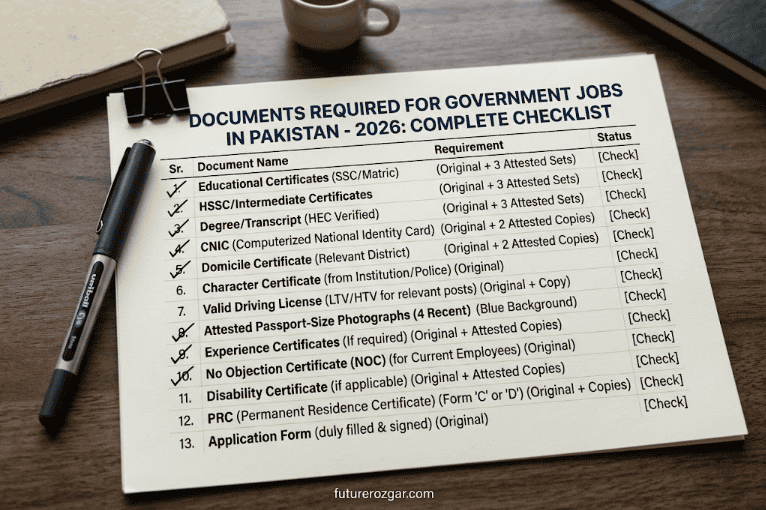
Documents required for government jobs in Pakistan usually include a valid CNIC, recent photograph, domicile, academic certificates, detailed marks sheets, experience letters, professional registration where applicable, and proof of application-fee payment. Some candidates also need a departmental permission certificate, disability certificate, equivalence letter or age-relaxation evidence. The exact requirement is always controlled by the official advertisement.
This practical 2026 checklist is designed for applicants using the National Jobs Portal (NJP), FPSC, PPSC, KPPSC, NTS and department-specific recruitment portals. It explains what to prepare before applying, what may be uploaded online, what must be kept for scrutiny, and what to carry on test or interview day.
Quick answer: Create one physical folder and one digital folder containing your CNIC, domicile, passport-size photograph, Matric-to-highest-degree certificates, transcripts or DMCs, experience certificates, professional licence, NOC/DPC if employed, quota certificates, fee receipt, submitted application, tracking ID and roll-number slip.
Government Job Documents Checklist at a Glance
Document
When It Is Usually Needed
Important Check
Valid CNIC
Registration, application, test and interview
Name, date of birth and CNIC number must match the application
Recent photograph
Online profile, application and roll-number slip
Clear face, plain background and correct file size
Domicile certificate
Provincial, district, zone and quota-based posts
District and province must match the claimed quota
Academic certificates
Eligibility and document scrutiny
Required degree must be completed by the closing date
Transcripts or DMCs
Marks, division, CGPA and subject verification
Keep records from Matric to the highest qualification
Experience certificates
Posts requiring professional experience
Designation, dates, duties and employer details should be clear
NOC or DPC
Government, semi-government or autonomous-body employees
Use the recruiting body’s prescribed format where required
Professional registration
Medical, engineering, nursing, legal and regulated posts
Registration should be valid on the relevant date
Fee receipt or PSID record
Paid applications and later verification
Keep the original or official transaction proof safely
Submitted form and tracking ID
Application record, correction and follow-up
Save PDF, screenshot and printout after final submission
Roll-number or admission slip
Written, screening or skill test
Check reporting time, venue and identification rules
1. Valid CNIC: The Main Identity Document
Your CNIC is the most important document in a Pakistani government-job application. Most portals use the CNIC number as the candidate’s unique identity. Enter it carefully and use the same format throughout the process. Your name, father’s or husband’s name, date of birth and gender should agree with your CNIC and academic records.
The National Jobs Portal registration page asks candidates for a CNIC number and an active email address. FPSC, PPSC, KPPSC and NTS systems also rely heavily on CNIC-based identification. A typing error can create login problems, duplicate profiles or a mismatch at the test centre.
Scan both sides clearly and keep a readable PDF or JPG.
Check the expiry date before applying.
Do not crop away the card edges or hide important information.
Never upload an edited CNIC that changes any official detail.
Carry the original CNIC on test and interview day unless the official instructions allow a stated alternative.
NTS states that candidates are identified through the original roll-number slip and original CNIC or valid passport. PPSC also emphasises original identity documentation for admission to examinations. Therefore, a photocopy alone should not be treated as a safe substitute unless the authority explicitly permits it.
2. Recent Passport-Size Photograph
Keep a recent, front-facing photograph with a plain background. The face should be visible and the image should not be blurred, heavily filtered or taken from a group photo. Many portals specify a maximum file size, image dimensions or allowed format, so prepare several versions without changing the appearance of the photograph.
A practical digital set is:
One high-quality original JPG.
One compressed JPG below 30 KB for portals with strict limits.
One version between 100 KB and 500 KB for modern application systems.
Six printed passport-size photographs for later scrutiny or interview.
FPSC’s online recruitment form includes a recent-picture upload and displays a file-size requirement on the form. PPSC provides separate photograph and CNIC-picture guidance. Always follow the live portal rather than forcing one saved image into every application.
3. Domicile Certificate and Quota Evidence
A domicile certificate proves the province or district against which you are applying. It is especially important for FPSC provincial quotas, PPSC Punjab posts, KPPSC zonal allocations, district-level vacancies and jobs reserved for a specific region.
Check these details before submission:
Province and district shown on the domicile.
Whether the advertisement asks for domicile, PRC or a local certificate.
Whether the post is open merit, provincial quota, zonal quota or district quota.
Whether a recently changed domicile is acceptable under the recruiting rules.
Whether your CNIC address and application details create an avoidable inconsistency.
KPPSC’s profile system asks candidates to select the district of domicile or area/zone according to the domicile certificate. Its advertisements also distribute posts through merit, zones and reserved quotas. Selecting the wrong district or zone can make an otherwise qualified application ineligible.
4. Matric, Intermediate and Higher Academic Certificates
Prepare academic records from Matric onward, even when the advertised post only mentions a Bachelor’s or Master’s degree. Recruiting bodies may verify your complete education history during scrutiny or interview. The safest file includes:
Matric certificate and DMC.
Intermediate certificate and DMC.
Bachelor’s degree and semester-wise or annual transcript.
Master’s, MPhil or PhD degree and transcript, where applicable.
Diploma, trade certificate or technical qualification required for the post.
Provisional certificate when the final degree has not yet been issued, if accepted.
Read the wording of the qualification carefully. A requirement such as “second division Bachelor’s degree in a relevant subject” is not automatically satisfied by any Bachelor’s degree. The discipline, duration, recognition, division, CGPA and date of completion can all matter.
Do not apply merely because your final result is expected soon. Unless the advertisement allows result-awaiting candidates, the required qualification normally needs to be complete by the closing date. A later result cannot always repair ineligibility that existed when applications closed.
5. Transcripts, DMCs and CGPA Evidence
A degree title confirms the qualification, but the transcript or detailed marks certificate proves subjects, marks, credit hours, division and CGPA. Keep both. Applicants often lose time because they upload a degree while the authority needs a transcript to confirm a required subject.
Where a university uses CGPA, keep the official transcript and any university-issued percentage or division conversion certificate. Do not rely on a self-made online conversion. When an advertisement specifies a percentage, division or CGPA, follow the authority’s stated equivalence rule.
6. HEC or IBCC Equivalence and Foreign Qualifications
Candidates with foreign degrees, non-standard qualifications or certificates issued under a different education system may need an equivalence document. HEC generally handles higher-education equivalence, while IBCC deals with school and intermediate-level equivalence.
Start equivalence early and never assume that a different degree title will be accepted without formal recognition where required.
7. Experience Certificates That Actually Prove Experience
For experience-based posts, a vague letter saying that a person “worked with the organisation” may not be enough. A strong experience certificate should clearly show:
Candidate’s full name.
Exact designation.
Start and end dates.
Full-time, part-time or contract status.
Main duties relevant to the advertised post.
Employer’s name, address and contact details.
Signature, designation and official stamp of the issuing authority.
Calculate experience only for periods you can document. If the advertisement requires post-qualification experience, work completed before the qualifying degree may not count. Overlapping jobs may also not be added twice. Keep appointment letters, contracts, salary records and relieving letters as supporting evidence where available.
FPSC warns that information claimed in the online application is treated as final and later experience claims may be considered an afterthought. Enter every relevant period correctly before final submission.
8. NOC or Departmental Permission Certificate
Applicants already working in government, semi-government, autonomous or semi-autonomous organisations may need to apply through the proper channel. Depending on the recruiting authority, this evidence may be called an NOC, Departmental Permission Certificate or DPC.
Request the NOC or DPC early and use the prescribed format where one exists.
KPPSC states that employees of government and related bodies may apply directly but must provide the prescribed Departmental Permission Certificate when required. Other authorities can use different procedures, so follow the specific advertisement.
9. Professional Registration or Licence
Regulated professions require current registration with the relevant body. Examples include:
Pakistan Medical and Dental Council for applicable medical posts.
Pakistan Nursing and Midwifery Council for nursing roles.
Pakistan Engineering Council for engineering posts where registration is required.
Provincial or Pakistan Bar Council evidence for legal practice where specified.
Teaching, pharmacy, accounting, architecture or technical licences mentioned in the advertisement.
Check whether the registration must be valid on the closing date, interview date or appointment date. Renew an expired licence before applying when possible, and keep both the registration card and online verification evidence.
10. Disability, Minority and Other Quota Certificates
Claim a reserved quota only when you possess the document required by the recruiting authority. A disability claim may require a certificate issued by the designated medical or rehabilitation authority. Minority, women, transgender, orphan, employee-child or other special quotas may have separate proof requirements.
KPPSC specifically notes that candidates applying against the disability quota must provide the required disability certificate when called. Do not select a quota simply because it appears in the form. An unsupported claim can cause rejection during scrutiny.
11. Age-Relaxation Documents
Some applicants qualify for general or category-specific age relaxation. Supporting evidence may include government-service records, disability documentation, tribal-area or regional certificates, ex-serviceman documents, widow or divorced-woman evidence, or another certificate listed in the relevant rules.
Calculate age on the date specified in the advertisement, usually the closing date. Do not subtract relaxation yourself and assume eligibility. Read the authority’s age-relaxation rules and select only the category you can prove.
12. Application Fee, PSID and Transaction Record
Many recruiting bodies use online fee payment through a generated PSID or 1Link channel. PPSC directs applicants to pay through supported digital and banking methods using the prescribed biller. FPSC’s online system generates a unique PSID, and its current guidance says applications are accepted after the required fee is paid through the official process.
Keep all of the following:
Generated PSID or challan number.
SMS or app payment confirmation.
Bank or mobile-wallet transaction ID.
Screenshot of successful payment.
Original treasury receipt where the authority still requires it.
A paid fee does not automatically mean the application is submitted. Return to the portal, complete the form, press the final submission button and confirm the submitted status. FPSC instructs applicants to preserve fee evidence for their record and, where required, produce the original receipt at the test.
13. Submitted Application, Tracking ID and Password Record
After applying, download or print the final application. Save the tracking ID, application number, selected post, case number, advertisement number and payment reference. Use a password manager or secure written record instead of repeatedly creating new profiles.
Your final folder should contain:
Submitted application PDF.
Screenshot showing successful submission.
Tracking or application ID.
Advertisement PDF.
Official job description.
Payment record.
Any confirmation email or SMS.
Documents Needed on Major Pakistani Recruitment Portals
National Jobs Portal (NJP)
NJP registration uses CNIC and email, with PAK-ID verification also available. Build a complete profile containing personal, education and experience details. Keep supporting documents ready even when a particular vacancy initially asks only for profile information. Use the official NJP registration page and track applications through your account.
FPSC applications are submitted online. Its recruitment guidance says candidates generally do not forward hard copies at the initial stage, should retain a printout, and must preserve fee evidence. Information entered in the online form is treated seriously, so include qualifications and experience correctly before submission.
PPSC uses online applications and online fee collection. Candidates should review its photograph, CNIC-image and fee-payment instructions before starting. Keep the submitted form, PSID payment record, CNIC, domicile and academic documents ready for later stages.
KPPSC’s profile asks for CNIC, domicile district or zone, active email and personal details. Its advertisements can state that documents are not required with the initial online application but must be submitted by candidates who qualify at the relevant stage. This does not reduce the need to prepare documents before applying; the information entered online must still be supportable.
NTS
NTS requirements vary by project. Some projects are fully online and state that no form or slip needs to be sent, while others require a printed form and supporting documents. NTS’s general guidance also stresses correct names, photographs, fee evidence and original identity documents at the test centre. Follow the instructions for the exact project, not an old application method.
Create a folder called Government Job Documents 2026. Use subfolders named Identity, Education, Experience, Quota, Fees and Applications. Save documents with clear names instead of camera-generated names.
Good examples include:
CNIC-Front-Muhammad-Ali.jpg
CNIC-Back-Muhammad-Ali.jpg
Domicile-Punjab-Lahore.pdf
BS-Computer-Science-Degree.pdf
BSCS-Transcript.pdf
Experience-Certificate-Company-Name.pdf
PPSC-PSID-Payment-Receipt.pdf
Scan in colour, keep text readable, rotate pages correctly and combine multi-page records into one PDF where the portal allows it. Do not upload password-protected files. Keep an untouched master scan and create compressed copies for portals with small upload limits.
Common Document Mistakes That Cause Rejection
Name or date-of-birth mismatch between CNIC and certificates.
Wrong domicile district, province, zone or quota selection.
Degree completed after the closing date.
Missing transcript when subjects or marks must be verified.
Experience certificate without dates, duties or official authentication.
Claiming post-qualification experience earned before the required degree.
Fee paid but application not finally submitted.
Blurry CNIC or photograph.
Expired professional registration.
Missing NOC or DPC for an employed applicant.
Unsupported age-relaxation or reserved-quota claim.
Not preserving the original fee receipt or roll-number slip.
Read the roll-number slip because test-day rules vary. A safe basic set is:
Original valid CNIC or the specifically allowed alternative.
Printed original roll-number or admission slip.
Original fee receipt where demanded.
Blue or black ballpoint pens, pencil, eraser and clipboard where permitted.
Any additional document mentioned on the slip.
Arrive before the reporting time. Do not carry prohibited electronic devices. NTS states that candidates should present the roll-number slip and original CNIC or valid passport for identification. FPSC and PPSC also publish test-specific admission instructions, which should take priority over general advice.
Frequently Asked Questions
Do I have to upload every document while applying?
No. Requirements differ. Some portals collect only profile information initially and call shortlisted candidates for document scrutiny. Others require selected scans with the online form. Follow the exact advertisement and portal fields.
Are attested copies required?
Not always at the initial online stage. Attested copies may be requested during scrutiny, interview or hard-copy submission. Do not spend money attesting every document until you read the current instructions.
Can I apply with an expired CNIC?
Online registration or test admission may fail with expired identification. Renew it as early as possible. A particular test authority may allow a limited alternative, but only its written instructions should be relied upon.
Is domicile necessary for every government job?
No, but it is required for many quota-based federal, provincial and district jobs. Check the advertised domicile condition before applying.
Does a CV replace academic and experience documents?
No. A CV summarises your background, but official certificates prove it. Prepare both. Use the FutureRozgar CV writing guide to create a clear job-focused CV.
Can I add experience after submitting an FPSC application?
Do not depend on that possibility. FPSC states that information claimed in the online application is treated as final and later claims may not be accepted. Enter all relevant experience accurately before submission.
Should I send a hard copy after applying online?
Only when the advertisement or project instructions require it. FPSC generally says no hard copy is needed at the initial application stage, while some NTS projects may require a printed form and documents. Always check the exact project page.
What if my degree title is different from the qualification wording?
Do not assume equivalence. Read the recognised-subject wording, contact the recruiting authority when necessary, and obtain HEC or IBCC equivalence where applicable.
Which document is most commonly forgotten?
Experience proof, domicile, NOC/DPC, transcript and fee records are common problem areas. The safest method is to use the checklist in this guide before every submission.
Final Checklist Before You Press Submit
I meet the education, age, domicile, gender, quota and experience conditions.
My name, CNIC and date of birth are entered correctly.
My required degree was complete by the relevant date.
Every experience claim can be proved.
I selected the correct post, case number and quota.
I used the official portal and official payment method.
The fee status is successful.
The application status is submitted, not incomplete.
I saved the form, tracking ID, advertisement and payment record.
I will keep checking the official website for test, interview or corrigendum updates.
Official Sources and Accuracy Note
This guide is based on the current application systems and published instructions of the National Jobs Portal, FPSC, PPSC, KPPSC and NTS. Recruitment procedures can change and individual advertisements can impose additional requirements.
Last reviewed: 25 July 2026.
Disclaimer: FutureRozgar is an independent information website and is not a recruiting agency. The official advertisement, recruitment portal and recruiting authority always take precedence over this guide. Read More: Cabin Crew Jobs in Pakistan 2026 — PIA, AirSial, Fly Jinnah & Serene Air