Fully Funded Scholarships for Pakistani Students 2026–27
Updated on August 7, 2026
🔄 Last updated: August 7, 2026
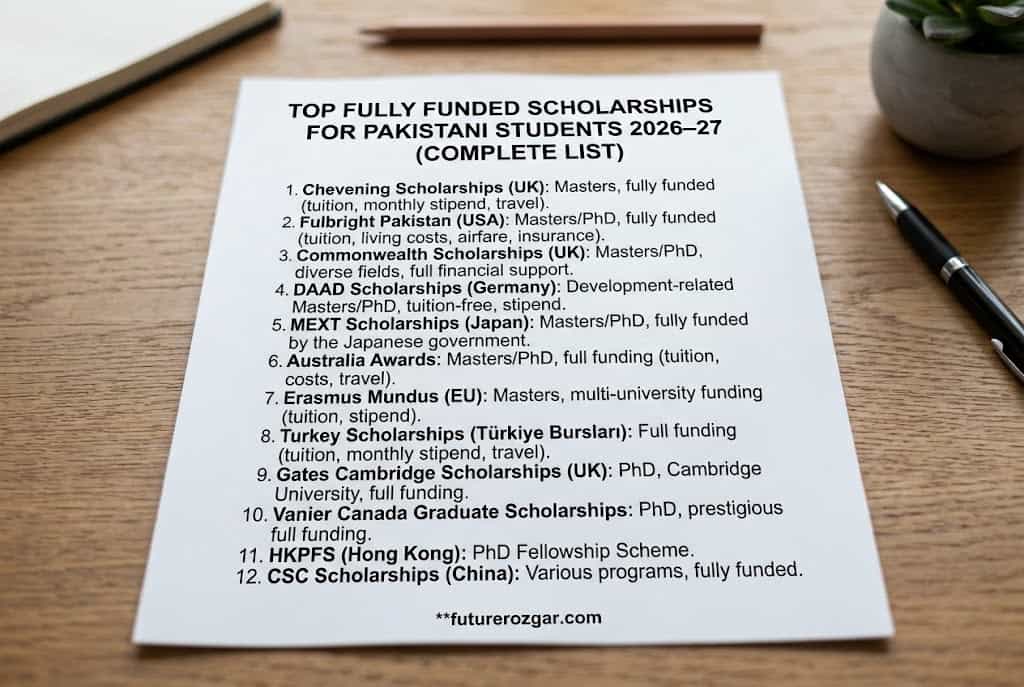
Pakistani Scholarships 2026 Studying abroad feels impossible for many talented Pakistani students because of high costs — but every year, hundreds of Pakistanis win fully funded scholarships that cover tuition, living stipend, health insurance and even air tickets. Here are the top programs open to Pakistani students for the 2026–27 cycle, with what each one covers and when to apply.
1. Fulbright Scholarship (USA)
Pakistan has one of the largest Fulbright programs in the world. It funds Master’s and PhD studies in the US in almost every field, covering full tuition, living stipend, accommodation, airfare and health insurance. Applications for Pakistani candidates are managed by USEFP (usefp.org) — the annual cycle typically opens in the first half of the year, so keep your documents, GRE and English test scores ready well in advance.
2. DAAD Scholarships (Germany)
Germany’s DAAD offers dozens of programs for Pakistani students, mainly at Master’s and PhD level. Monthly stipends are roughly €992 for graduates and €1,400 for doctoral candidates, plus other benefits depending on the program. Deadlines for the popular development-related (EPOS) programs generally fall between August and October each year for courses starting the following academic year — meaning the 2026 window is opening soon. A big advantage: many DAAD scholarships are pre-admission, so you can apply for funding before university admission. Details at daad.pk.
3. Chevening Scholarship (UK)
The UK government’s flagship award funds a one-year Master’s at any UK university — tuition, monthly stipend, flights and visa costs. Chevening looks for leadership potential and normally requires at least two years of work experience. Applications usually open in early August each year at chevening.org.
4. Türkiye Bursları (Turkey)
Turkey’s government scholarship covers undergraduate, Master’s and PhD studies — tuition, monthly stipend, accommodation, health insurance, a one-year Turkish language course and return flight tickets. It is one of the few fully funded options available at undergraduate level, making it extremely popular with FSc/A-Level students. Applications typically open in January–February at turkiyeburslari.gov.tr.
5. Chinese Government Scholarship (CSC)
Available at more than 280 Chinese universities for Bachelor’s, Master’s and PhD programs. It covers tuition, university accommodation, basic health insurance and a monthly allowance of up to 3,500 Yuan for doctoral students. Applications generally run from December to March/April for the September intake, through campuschina.org or directly via Chinese universities.
6. MEXT Scholarship (Japan)
Japan’s MEXT scholarship funds undergraduate, Master’s, PhD and training programs — tuition, monthly living allowance and round-trip airfare. Embassy-recommended applications are announced through the Embassy of Japan in Pakistan, usually in the second quarter of the year.
Pakistan’s Higher Education Commission runs its own overseas scholarship programs for Master’s and PhD studies at top international universities in priority fields, plus large indigenous programs for study within Pakistan. Announcements appear on hec.gov.pk — competition is intense, so strong academics are essential.
How to Maximize Your Chances
Start 6–9 months early — most rejections happen because of late preparation, missing documents or weak statements of purpose
Prepare English test scores (IELTS/TOEFL) in advance where required — though some programs accept alternatives
Write a specific, honest statement of purpose — generic essays fail
Get recommendation letters from teachers who actually know your work
Apply to multiple programs — never rely on a single application
Use only official websites; never pay any “agent” who guarantees a scholarship
Note: Deadlines and benefits change every cycle. Always confirm current dates and requirements on each program’s official website before applying. FutureRozgar is an information platform and is not affiliated with any scholarship provider.
Four More Scholarships Worth Your Shortlist
8. Erasmus Mundus Joint Masters (Europe)
Funded by the European Union, these joint master’s programs let you study in two or three European countries within one degree, with tuition, a monthly allowance and travel covered for scholarship holders. Each program has its own consortium, deadline (mostly winter, for the following autumn intake) and requirements — browse the official Erasmus Mundus catalogue and apply directly to programs matching your field.
9. Commonwealth Scholarships (UK)
Fully funded UK master’s and PhD scholarships for citizens of Commonwealth countries, covering tuition, stipend and airfare, with financial need taken into account. Pakistani applicants typically route through HEC as the nominating agency alongside the Commonwealth Scholarship Commission’s own portal — watch both when the cycle opens.
10. Australia Awards (Australia)
The Australian government’s flagship development scholarships fund full tuition, living expenses, travel and establishment costs for master’s study, prioritizing fields tied to Pakistan’s development. Strong professional experience and a clear return-home contribution plan are central to selection.
11. Stipendium Hungaricum (Hungary)
Hungary offers hundreds of fully funded seats to Pakistani students each year across bachelor’s, master’s and PhD levels under a bilateral agreement — tuition-free study, a monthly stipend, dormitory accommodation and medical insurance. Applications go through the Tempus Public Foundation portal, with HEC handling Pakistan-side nomination. Its bachelor’s-level funding makes it rare and especially valuable for intermediate students.
Which Scholarship Fits Your Profile?
Fresh graduate, high grades, no work experience: Erasmus Mundus, Stipendium Hungaricum, Chinese Government Scholarship and MEXT are your strongest lanes — they don’t demand professional experience.
2+ years of professional experience: Chevening, DAAD EPOS, Australia Awards and Fulbright actively prefer professionals with a development story.
Intermediate/FSc student wanting a funded bachelor’s: Stipendium Hungaricum and Türkiye Bursları are among the few fully funded undergraduate routes.
Researcher aiming for a PhD: Commonwealth, DAAD research grants, CSC and HEC overseas schemes fund doctoral study generously.
Master Document Checklist
Nearly every scholarship above draws from the same document pool. Prepare these once, keep them updated in a single folder, and every application becomes a matter of days instead of weeks:
Attested transcripts and degrees (matric through latest qualification), plus HEC attestation where required
Valid passport — apply now if you don’t have one; it takes time
English test score (IELTS Academic or TOEFL) — one strong score serves dozens of applications for two years
A master CV in international format, trimmed per application
A base motivation letter and study plan you customize for each program
Two to three referees who agree in advance to write for you, with their letters’ drafts discussed
Research proposal (for research degrees), reviewed by a mentor in your field
Frequently Asked Questions
Can I apply to several scholarships in the same year?
Yes, and you should — cycles overlap conveniently, and nothing stops you holding multiple offers before choosing. Serious candidates typically run four to six applications per cycle.
Is IELTS compulsory for all of these?
Not all. Several Chinese, Turkish and Hungarian programs accept English proficiency letters or conduct their own assessment, while UK, US and Australian awards effectively require IELTS or TOEFL. Taking the test anyway maximizes your options.
Do low grades end my chances?
A modest CGPA narrows but doesn’t close the field. Experience-weighted awards like Chevening and Australia Awards care about leadership and impact; a strong professional record and outstanding essays regularly beat higher-CGPA applicants with generic files.
Are these scholarships really free, or are there hidden costs?
The awards themselves charge nothing — beware anyone selling “guaranteed scholarships”. Your real costs are test fees, document attestation and courier charges, typically a small fraction of one month’s funded stipend.
When should I start preparing for the 2027 intake?
Now. Most 2027-intake deadlines fall between mid and late 2026. Documents, IELTS and referee commitments done this quarter mean every deadline after that is just assembly.