Job Interview Preparation in Pakistan – 10 Common Questions
Updated on August 7, 2026
🔄 Last updated: August 7, 2026
job interview preparation You’ve made it past the CV screening — congratulations, you’re already ahead of 90% of applicants. But in Pakistan’s job market, the interview is where most candidates fall. Whether it’s a government interview panel, a bank’s MTO assessment, or a private company’s HR round, the candidates who get selected are almost never the “most talented” — they’re the best prepared. This guide covers exactly how to prepare, what questions to expect, and the mistakes that quietly destroy your chances.
Before the Interview: The 3-Day Preparation Plan
Day 1: Research the Organization
Spend one hour learning about the employer: what they do, their main products or departments, recent news, and who their competitors are. For government interviews, understand the department’s role and its parent ministry. Interviewers can immediately tell who Googled the company and who didn’t — and “What do you know about us?” is one of the most common opening questions in Pakistani interviews.
Day 2: Prepare Your Answers
Write down and practice answers to the 10 questions listed below. Don’t memorize scripts word-for-word — that sounds robotic. Instead, prepare bullet points and practice saying them out loud until they flow naturally. Practicing in front of a mirror or recording yourself on your phone reveals nervous habits you didn’t know you had.
Day 3: Logistics & Documents
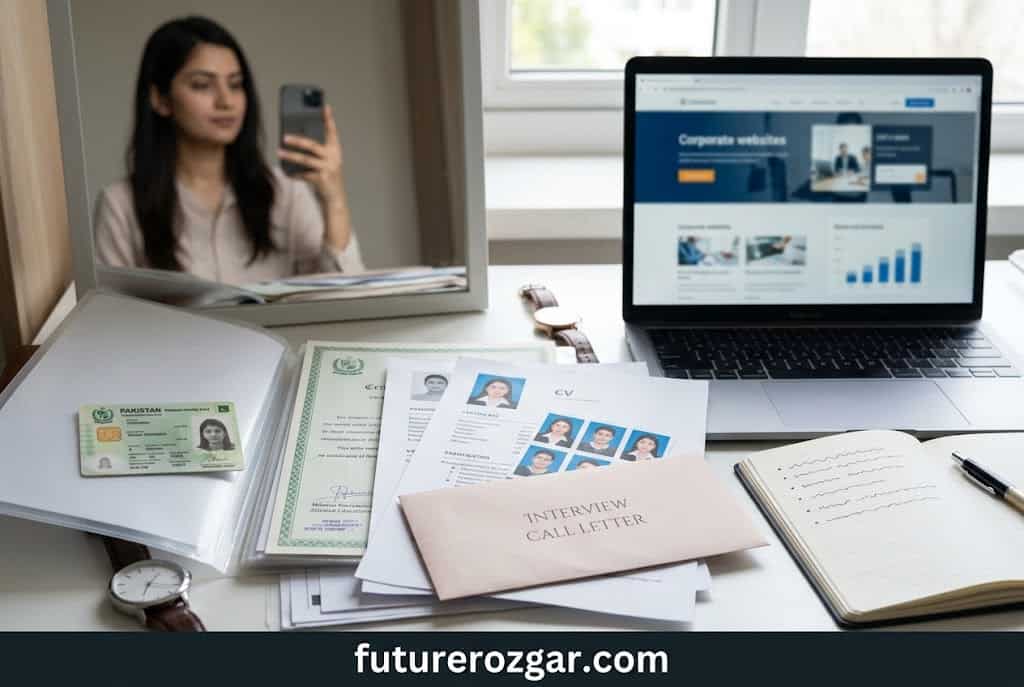
Prepare a folder with: original CNIC, original educational documents plus attested copies, 2–3 printed CVs, passport-size photos, and the interview call letter. Plan your route and aim to arrive 20–30 minutes early — being late to an interview in Pakistan is usually an automatic rejection, regardless of your excuse.
The 10 Most Common Interview Questions in Pakistan (And How to Answer)
1. “Tell me about yourself.”
The most common opener. Give a 60–90 second professional summary: education, key experience or projects, main strengths, and why you’re here. Do not recite your entire life story or repeat your CV line by line.
2. “Why do you want this job?”
Connect your skills to their needs. Weak answer: “I need a job.” Strong answer: “My finance degree and internship in credit operations match this role, and your bank’s expansion into digital banking is an area I want to build my career in.”
3. “What are your strengths and weaknesses?”
Strengths: pick two that are relevant to the job, each with a one-line example. Weaknesses: name a real but non-fatal weakness plus what you’re doing about it (“My written English was average, so I’ve been taking an online business writing course”). Never say “I’m a perfectionist” — every interviewer has heard it a thousand times.
4. “Why should we hire you?”
Summarize your top 2–3 qualifications for this specific role and show enthusiasm. This is your closing argument — prepare it well.
5. “Where do you see yourself in 5 years?”
Show ambition within the organization: “Growing into a senior role in this department, having mastered the core operations.” Avoid answers that suggest you’ll leave quickly.
6. “What is your expected salary?”
Research market rates beforehand. Safe answer for freshers: “I’m flexible and open to your standard package for this position; my priority is the learning opportunity.” For experienced candidates: give a researched range, not a single number.
7. “Why did you leave your last job?” / “Why is there a gap?”
Never badmouth a previous employer — it’s the fastest way to look like a future problem. Frame it positively: growth, learning, or family circumstances now resolved. For gaps, be honest and brief (exam preparation, family responsibility, health now recovered).
8. Subject-knowledge questions
Expect 2–4 technical questions from your field — accounting standards for finance roles, basic law for legal posts, current affairs for government positions. Revise your core subject fundamentals; interviewers test depth, not memorized definitions.
9. Current affairs (especially government interviews)
Panels for government posts frequently ask about national issues, the economy, and your district. Read a quality newspaper daily for the two weeks before your interview.
10. “Do you have any questions for us?”
Always ask 1–2 questions — it signals genuine interest. Good options: “What does success look like in this role in the first six months?” or “What training do new hires receive?” Never ask about leave policy or salary in the first interview unless they raise it.
Dress Code & Body Language
Men: dress shirt and trousers (plain, pressed); a suit for bank/corporate roles. Clean shave or neatly trimmed beard, polished shoes.
Women: professional shalwar kameez or business attire, minimal jewelry and makeup.
Body language: firm handshake (if offered), sit upright, maintain natural eye contact with all panel members, and don’t fidget with your phone, pen, or file. Switch your phone off — not silent, off.
Language: answer in the language the interviewer uses. If you’re stronger in Urdu, it’s perfectly fine to say so politely for detailed answers — clear Urdu beats broken English every time.
5 Mistakes That Quietly Destroy Interviews
Arriving late — plan for traffic, arrive 20–30 minutes early.
Not knowing your own CV — if you claimed a skill or project, be ready to discuss it in detail.
One-word answers — expand with brief examples; interviews are conversations, not interrogations.
Lying — experienced panels catch inconsistencies quickly, and one caught lie ends everything.
Giving up after one bad answer — panels expect nervousness; recovering gracefully actually impresses them.
After the Interview
For private-sector roles, a short, polite follow-up email after 5–7 working days is appropriate if you haven’t heard back. For government posts, results follow the official process — keep checking the department’s website and your application portal. And regardless of the outcome, write down the questions you were asked; every interview is free training for the next one.
Frequently Asked Questions
How early should I arrive for an interview in Pakistan?
Aim to reach the venue 20–30 minutes before your scheduled time. This covers security checks at government buildings and gives you time to settle your nerves.
Should I answer in English or Urdu?
Follow the interviewer’s lead. Clear, confident Urdu is far better than struggling English. For bank and multinational roles, some English proficiency is usually expected, so practice your core answers in both.
What documents should I bring?
Original CNIC, original degrees and certificates plus attested copies, printed CVs, passport photos, and the interview call letter. For government interviews, bring everything listed in the call letter — missing documents can disqualify you on the spot.
What if I don’t know the answer to a question?
Say honestly: “I’m not certain about that, but my understanding is…” or “I don’t know, but I’d be keen to learn.” Honest uncertainty beats confident nonsense — panels respect it.